technical-timing
Great Company, Bad Entry: Why Stock Quality and Timing Are Different
A strong business can still be a poor entry. Learn how to separate company quality, valuation context, and technical timing, and why chasing extended quality names is a common research mistake.
For information and education only — not investment advice or a recommendation. Do your own research. Capital at risk.
The short answer
A great company can still be a bad entry. Quality tells you whether a name deserves research attention. Valuation asks what you are paying for that quality. Timing asks whether price structure and trend context support acting now, waiting, or standing aside. Mixing those questions is how people find a strong business after the market has already priced a large part of the story, then treat late discovery as urgency. Patience is not indecision. It is a separate skill.
Why this matters
Most regret after buying a "quality" name comes from collapsing three questions into one emotional conclusion: this is a strong company, so I should own it now.
That collapse is expensive in two directions. You pay for peak urgency on a name that still deserved a file, then spend months waiting for digestion that may not come on your clock. Or you treat every decline as a gift and step into a breakdown because the brand is beloved.
The same error shows up in reverse. A clean chart can upgrade a weak business in your head. Momentum is not cash flow. A tidy bounce is not durability.
Investor education from Investor.gov and FINRA still starts with research discipline, not urgency. UK readers should keep FCA InvestSmart in view: capital is at risk, and waiting patiently does not remove that risk.
This piece is educational material for self-directed research. It is not personalised advice and not a recommendation to buy or sell any security.
Quality, valuation, and timing are different jobs
Separate the questions on purpose.
| Question | What it studies | What it does not decide |
|---|---|---|
| Quality | Business strength, durability, profitability, cash, balance sheet | Whether today's price is a good entry |
| Valuation | What you pay relative to earnings, cash flows, peers, history | Whether the trend is supportive right now |
| Timing | Trend, momentum, extension, higher-timeframe structure | Whether the business is high quality |
You can believe a business is strong, believe the long-term valuation case is still open for research, and still conclude that the entry is poor. That combination is common. It is also uncomfortable, which is why people skip it.
For the quality side of the work, start with How to Find Quality Growth Stocks. For combining the lenses in one workflow, see How to Combine Fundamentals, Valuation and Technical Timing.
Primary company facts still live in filings. When a name matters enough to keep, open SEC EDGAR. Charts do not replace disclosures.
Why strong businesses become extended
Extension is not a moral failure of the company. It is a market state.
Typical paths into "great company, bad entry" include:
Narrative crowding. Many investors discover the same story at once, so demand for shares rises faster than new information.
Earnings-momentum feedback. Strong results attract attention, attention lifts the price, the lift attracts more attention.
Index and factor flows. Passive and systematic buying can push already-popular names further without changing the underlying business that week.
Positioning squeezes. Price can move violently for reasons that have little to do with next year's free cash flow.
Time compression. Months of re-rating can happen in weeks when a theme catches fire.
None of this proves the business has worsened. It proves that your entry problem may have worsened. Technical analysis education bodies such as the CMT Association treat price and volume behaviour as a study of market participation and risk, not as a substitute for fundamental research.
Imagine a durable compounder that has already run hard, sits far above its rising longer-term averages, and prints consecutive gap-ups on enthusiasm. The business may still be strong. The research question for a new buyer is whether waiting for digestion is more rational than paying for peak urgency. That is a process question, not a ticker call.
For a focused discussion of extension and chase behaviour, see How to Avoid Chasing an Overextended Stock.
Pullback versus breakdown
Not every decline is an opportunity. Distinguishing a pullback in an intact structure from a breakdown in a damaged structure is core timing hygiene.
Pullback
Characteristics that often appear together (none alone is decisive):
- Higher-timeframe trend still rising or stable
- Decline toward a well-watched average or prior consolidation zone
- Volume that cools rather than panics without reason
- Business news that does not invalidate the thesis
- Volatility that expands then contracts as price digests
A pullback is a pause that may offer a cleaner look later. It is not a promise that price will resume.
Breakdown
Warning signs that the timing problem may be structural:
- Weekly structure loses a sequence of higher highs and higher lows
- Price accepts below a level that previously defined the trend
- Momentum deteriorates across timeframes, not only on one noisy day
- The fundamental narrative also weakens: missed growth, margin break, balance-sheet stress
A breakdown does not automatically mean "never own this company." It means do not treat this dip as a routine pullback in a healthy trend.
Weekly versus daily: which timeframe answers which question?
Retail investors often overfit to the most recent candles. A cleaner habit is to assign jobs to timeframes.
Long-term (weekly)
Use weekly structure to ask whether the primary trend still supports a multi-month thesis, whether the market has accepted a lower regime or this is still a pause inside a larger advance, and whether you are fighting the higher-timeframe tide for a short-term bounce.
Weekly context is slower and less noisy. It is usually the better place to judge whether a quality name still has constructive market structure for longer holding periods.
Position (daily)
Use daily structure to ask whether the name is extended, compressing, or rebuilding after a pullback; whether you are looking at a sharp sentiment spike or a measured advance; and whether short-term momentum has cooled enough that a patient entry plan is even plausible.
Daily context is useful for position-style timing. It is a poor place to redefine the entire business thesis every session.
PRISM's model-status language is designed for that separation. On the timeframes PRISM currently generates (Long-term weekly and Position daily), user-facing setup states include Emerging, Favourable, Monitoring, Target reached, Stop reached, Expired, Unfavourable, and Invalidated. Those are research labels, not order instructions. Favourable does not mean buy. Monitoring does not mean sell.
A tidy daily bounce inside a weekly breakdown is a different research object from a tidy daily bounce inside a weekly advance. Name the regime before you name the entry.
Superinvestor ownership does not fix a bad entry
Long-term institutional ownership can be useful context. It does not erase extension risk.
Copying "smart money" fails as an entry timer for familiar reasons. 13F filings are delayed, so positions can change before you see them. Managers have different constraints: liquidity, benchmarks, taxes, and mandate rules are not your constraints. Average cost basis differs; a holder who built a position years earlier is not making your decision today. A large weight does not tell you whether the next month of price action will be gentle.
Treat superinvestor data as a Conviction lens: inspectable context from holder filings. It does not currently drive the ranked Score, and it is not timing permission. Quality can align with ownership and still leave you with a bad entry. For the ownership side in depth, see What Do Superinvestor Holdings Really Tell You?.
A practical quality / timing matrix
Use this matrix as a scanning aid, not as an automated rulebook.
| Supportive timing | Weak or extended timing | |
|---|---|---|
| Strong quality | Strong research priority for deeper work; still verify valuation and risks | Watchlist and patience; study pullback conditions; avoid inventing urgency |
| Mixed / uncertain quality | Investigate carefully; do not let a clean chart upgrade a weak business | Usually low priority; both questions ask you to wait or pass |
| Weak quality | Timing rarely rescues a poor business for long-horizon research | Pass; spend attention elsewhere |
Two traps to avoid when using any matrix: upgrading quality because the chart is strong, and ignoring broken structure because the brand is beloved. Loyalty to a narrative is not risk management.
The product vocabulary for the same split is PRISM Score vs PRISM Setup. Score orders research attention. Setup describes current technical state. They can agree or pull apart. That disagreement is often the "great company, bad entry" case.
Common mistakes
Treating discovery as a deadline. Finding a company late feels like falling behind. Markets do not owe you a discount for arriving late. If the structure is extended, your edge (if any) is often the willingness to wait.
Averaging into strength without a plan. Adding because price is rising can work in trends and still be poor process if you never defined invalidation. Decide in advance what would make the entry thesis wrong.
Confusing volatility with opportunity. A sharp two-day drop after a vertical rise may still leave the name extended on the weekly chart. Distance travelled matters as much as the latest red candle.
Using valuation language as timing language. "It was more expensive last month" is not the same as "structure supports a new commitment today." Both can be true or false independently.
Outsourcing patience to a tip culture. Screenshots of winning entries after the fact teach little about the waiting that preceded them.
Ignoring higher-timeframe damage. Name the weekly regime before you name the daily entry.
Reading holder filings as entry permission. Delayed ownership context does not fix extension.
How PRISM helps
PRISM deliberately separates opportunity quality from entry timing.
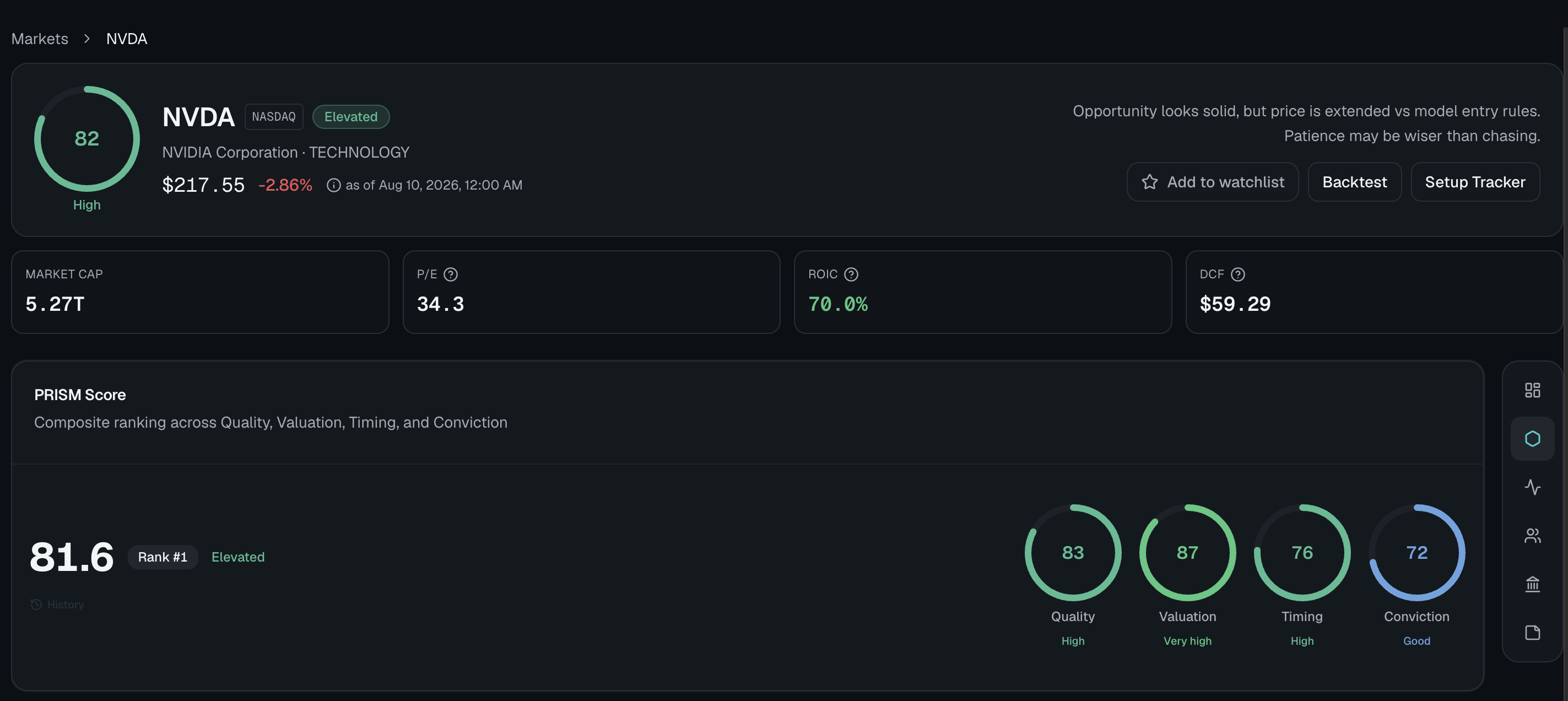
PRISM Score is a 0-100 research-priority model score. You read an opportunity through four research lenses (Quality, Valuation, Timing, Conviction) as a navigation frame. Those lenses organise attention. They are not a validated predictive ranking. Conviction is inspectable holder-filing context. It does not currently drive the ranked Score.
PRISM Setup is model status around timing and structure on the timeframes PRISM currently generates. User-facing states include Emerging, Favourable, Monitoring, Target reached, Stop reached, Expired, Unfavourable, and Invalidated. These labels describe research context for patience and readiness. They are not broker instructions and not promises about outcomes.
A name can score well on business quality while Setup status stays in Monitoring because structure is extended or the higher-timeframe trend needs repair. That combination is exactly the "great company, bad entry" case. The product is doing its job when it refuses to flatten those ideas into one story.
Rating bands (Highlighted, Elevated, Monitor, Weak setup, Low score) are scanning aids. A given band can be sparsely populated depending on current scores. PRISM does not publish those weights.
See how PRISM separates opportunity quality from entry timing
Your working checklist
Before you treat a quality name as "ready" in your own process:
- Have I written the business thesis separately from the entry thesis?
- What does the weekly (Long-term) structure say about regime: advance, digestion, or damage?
- What does the daily (Position) structure say about extension versus compression?
- Am I describing a pullback in an intact trend, or talking myself into a breakdown?
- What would falsify the entry idea within a defined period?
- Am I acting because the company is good, or because I fear missing a move?
- Have I checked whether valuation context still belongs in the conversation?
- If ownership data looks supportive, have I still respected filing delay and non-personalisation?
- Would I still want this research priority if price went nowhere for months?
- Have I opened primary disclosures for any name I might keep on a list?
If the honest answers point to patience, patience is the professional conclusion, not a failure to be bold.
Limitations
Technical context has limits. Charts reflect participation and risk; they do not reveal intrinsic value by themselves. Patterns rhyme more than they repeat; similar shapes can lead to different outcomes. Liquidity events, gaps, and news can invalidate tidy structures quickly. Indicator settings are judgement calls; there is no universal correct calibration for every name.
PRISM model statuses are research aids with assumptions and coverage limits. They are not personalised recommendations and not a public Track Record claim in this article. Fundamentals have limits too. A clean business can re-rate lower for years if expectations were excessive. Separating quality from timing reduces one class of error. It does not eliminate loss.
Risk disclosure
Buying and selling shares can result in losses, including loss of the capital you put at risk. A high-quality business can still fall in price. Waiting patiently does not protect you from further declines. Nothing on this page is a personal recommendation, an offer to deal in securities, or assurance of any result.
Historic price moves and prior model statuses are unreliable guides to what comes next. Review PRISM's risk disclosure. If you need advice about your own situation, consult a suitably authorised adviser. Worked examples here are for teaching only.
UK readers: PRISM is not FCA-authorised. Capital is at risk.
Sources and methodology
Framing follows the public methodology: Score as a 0-100 research-priority model score; Setup statuses Emerging through Invalidated on the timeframes PRISM currently generates; research lenses as navigation rather than a validated predictive ranking; Conviction as inspectable context that does not currently drive the ranked Score; no internal weight percentages; no public Track Record claim. Primary education sources include the CMT Association, Investor.gov, FINRA, FCA InvestSmart, and SEC EDGAR. Price updates faster than filings; treat any timing label as provisional when as-of dates are unclear.
Last reviewed: 2026-08-16
See the product
Ranked Opportunity Radar with quality, valuation, growth, timing, and conviction pillars, so research stays organised before you act.
Try Radar free
Explore the deeper Radar workflow free for a limited time. Basic research stays free forever — no credit card to start.
For information and education only. Capital at risk.
Sources
Related reading
- How to Avoid Chasing an Overextended Stock
Learn what price extension means, how moving averages and RSI add context, how to tell a breakout from a chase, and how patient timing labels support better research discipline.
- PRISM Score vs PRISM Setup: What Is the Difference?
PRISM Score is a longer-lived research-priority model score. PRISM Setup is the current technical state on the timeframes PRISM currently generates. Learn how they differ, when they pull apart, and how to use each without treating either as a tip.
For information and education only — not investment advice. Capital at risk. How PRISM works · Risk disclosure · Methodology methodology-2026-08