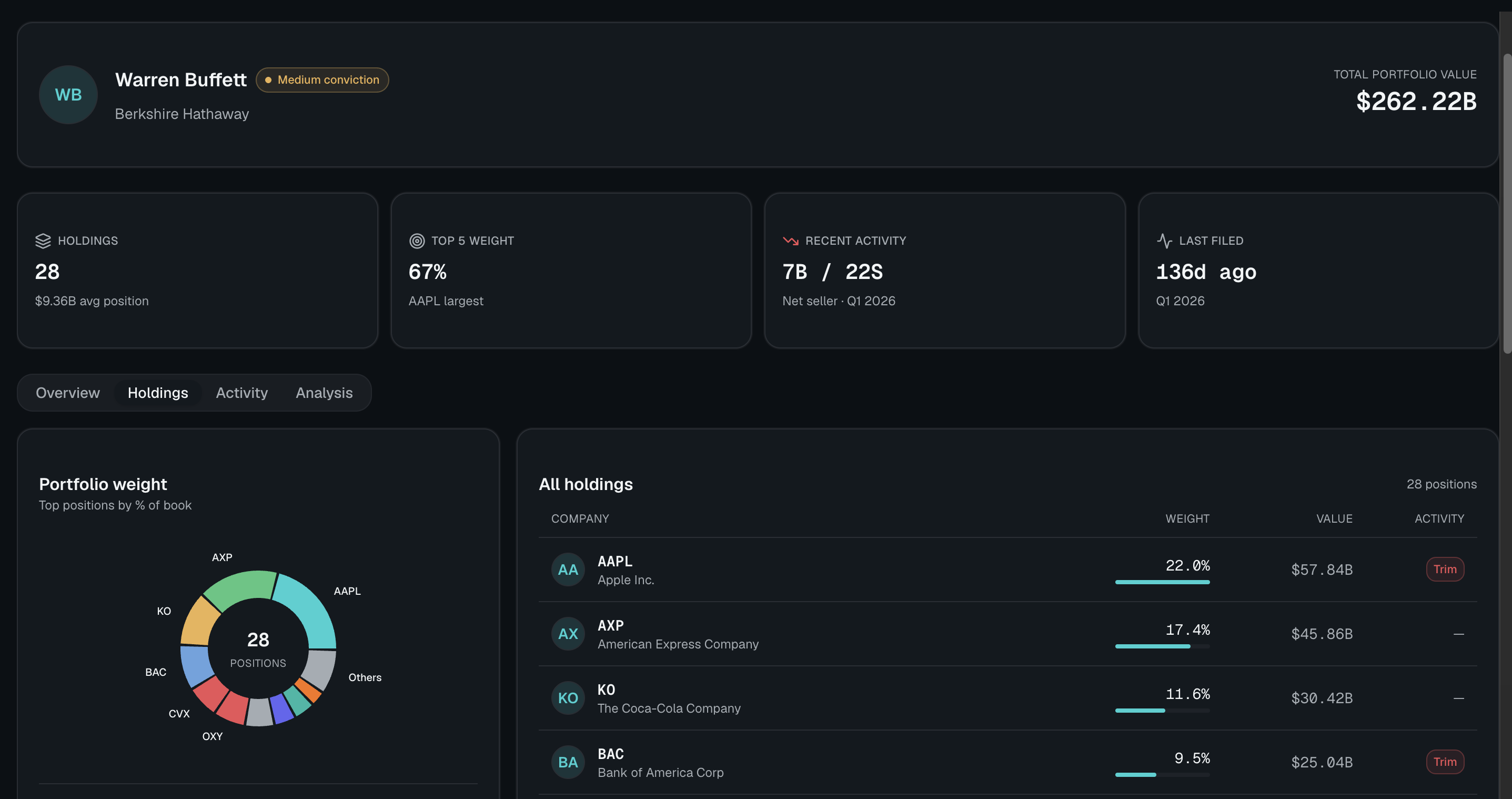
A clear guide to reading superinvestor and 13F holdings as research context: what filings contain, what they omit, why delays matter, and how to combine conviction with quality and valuation without copy-trading.
For information and education only — not investment advice or a recommendation. Do your own research. Capital at risk.
The short answer
Superinvestor holdings, usually read from US Form 13F filings, show where certain large institutional managers disclosed long equity positions at a past quarter-end. They can reveal initiation, adding, trimming, exiting, and rough portfolio weight. They do not tell you the manager's entry price today, short positions, most non-equity exposures, intra-quarter trading, or whether the idea fits your goals. Used well, 13F-style data is a conviction context layer after you understand business quality and valuation. Used poorly, it becomes a delayed popularity contest.
Why this matters
People treat famous ownership as a shortcut past the hard work. The cost is familiar: you copy a dated snapshot, ignore what the filing leaves out, and confuse someone else's allocation choice with your own decision.
Filing delay is the feature most readers forget. By the time a position is widely discussed, the manager's current book can already differ. Crowded follow-on flows appear because popular disclosed names attract attention precisely because they were disclosed. A viral post about a famous holder can lag reality by a full quarter or more.
Investor.gov and FINRA both stress researching investments with primary sources and clear-eyed limitations. 13F data is one source among many: useful for mapping reported long conviction, weak as a complete portfolio x-ray. UK readers should keep FCA InvestSmart in mind: tools and filings do not remove capital risk.
This guide is for education and research process design. It is not a recommendation to copy any manager, and not a call to buy or sell any security.
What a 13F contains
In the United States, Form 13F is a quarterly holdings report filed by certain institutional investment managers. The SEC maintains educational material on the form, including an page and glossary coverage on . Filings themselves are accessible through .
See the product
Ranked Opportunity Radar with quality, valuation, growth, timing, and conviction pillars, so research stays organised before you act.
A practical, repeatable framework for researching quality-growth stocks: revenue and earnings durability, profitability, cash flow, balance-sheet resilience, and valuation sanity, without treating any screen as a buy signal.
At a high level, a 13F-type snapshot can help you observe:
Which US-listed equity and certain equity-related securities were reported as long holdings
How many shares were reported at period-end
The market value of those reported positions at the filing's valuation approach for that period
Period-end timing
It is a photograph as of the quarter's end, not a live feed.
Researchers often derive activity by comparing consecutive periods: new positions, increased positions, decreased positions, and disappearances from the reportable set. Those derived labels are analytical conveniences. They are only as good as the comparison method and the filing's completeness for your question.
Honest research language sounds like: as of the last reported quarter-end, this manager disclosed a position of roughly this share of the reported 13F book. Anything snappier usually overclaims.
What a 13F leaves out
The omissions are as important as the contents.
A standard 13F-oriented view typically does not show:
Short positions. Bearish exposure can be invisible in the long-only report view.
Intra-quarter trades. A manager could buy after quarter-end, or sell before the next filing is visible to you.
Many non-13F assets. Cash, many bonds, private holdings, and other instruments may sit outside what you are reading.
Options and complex hedges in full economic detail. Even when some equity-related securities appear, the true net exposure can differ from a simple share count story.
Thesis text. Filings list positions. They do not publish the investment memo.
Your constraints. Taxes, account size, mandate, and risk tolerance are yours alone.
Future intentions. A large weight is not a promise to hold forever.
Reporting thresholds, amendments, and restatements can change interpretations. Data vendors and research platforms may normalise filings differently. Know your pipeline's assumptions before you treat a derived "new" or "exited" label as fact.
Filing delay: the feature people forget
13F reporting is delayed by design relative to live markets. Managers file after quarter-end within regulatory timelines, and researchers often see positions weeks after the economic decisions were made. In fast markets, that gap is not a footnote. It is the point.
Practical consequences follow.
You may be copying a past self. The manager's current book can already differ. Crowded follow-on flows can appear because disclosed names attract attention. Stale "smart money" narratives travel well. False precision is easy: quoting an exact share count from last quarter as if it were today's truth creates fake confidence.
Treat the disclosure date as a disclosure date, not as a trade date. If you cannot say the as-of quarter out loud, you are not ready to use the filing in a thesis.
New, added, trimmed, exited
Comparing filings across periods is where 13F research becomes interesting, and where methodology mistakes multiply.
New (initiated)
A name appears that was absent last period. Ask whether it is a true new idea or a security that crossed a reporting threshold or classification change. Is the starting weight tiny (a toe-hold) or already meaningful? Does the business quality deserve attention independent of the famous name on the filing?
Added (increased)
Share count or value weight rises versus the prior period. Ask whether the add is large relative to the manager's book, or a small top-up. Could price appreciation alone change market value without a bullish "vote"? Does the add coincide with improving or deteriorating fundamentals?
Trimmed (reduced)
Position shrinks but remains. Is that risk reduction, rebalancing after a rise, or fading conviction? Is the remaining weight still large enough to matter in that book? Are multiple managers trimming the same theme (context), or is this idiosyncratic?
Exited (removed)
The position disappears from the reported set. Was it a full sale, or a drop below relevance in the reportable universe? Did the thesis break, or did a better idea displace capital? Are you seeing an exit after a large run (discipline) or after deterioration (damage control)?
Suppose several well-known managers show a newly reported small position in the same name after a sharp drawdown, while one long-time holder trims a still-large weight. That pattern is research context: a prompt to study quality, valuation, and structure. It is not a signal that the stock is approved.
Portfolio weight and persistence
A ticker appearing in a famous portfolio is trivia. Weight is closer to conviction.
A stub position can be a remnant or an experiment. A top-ten weight is a stronger statement about that manager's allocation choices at that date. Changes in weight can come from trading, from price moves, or from changes in the rest of the book.
When you read institutional maps, prefer this order:
Who holds it
How large the position is in that holder's reported book
Whether breadth of holders is wide or narrow
Whether recent periods show persistence or churn
Name-dropping without weight is how social media turns 13F season into theatre.
One filing is a snapshot. Several filings create a thin time series.
Persistence questions worth asking: Has the manager held through at least a few reporting periods? Are adds clustered after drawdowns, after sharp advances, or seemingly steady? Is ownership breadth rising while weights stay meaningful, or is interest becoming more speculative and short-lived among filers?
Persistence does not prove correctness. Managers can be persistently wrong. It does change the research interpretation: a multi-period holding with stable or rising weight is different evidence from a one-quarter appearance that vanishes.
Conviction trend (whether reported ownership is building, stable, or fading across recent periods) is useful as context beside your own quality and valuation work. It is not a substitute for that work.
Why copying superinvestor portfolios fails
Copying fails for structural reasons, not because famous investors are unskilled.
Different opportunity sets. Large managers face liquidity constraints you may not face, and sometimes opportunities you cannot access. The reverse is also true: you can own small positions they cannot.
Different mandates. A fund may need to manage tracking error, redemption risk, sector limits, or marketing narratives. Your account does not share those rules.
Different cost basis and taxes. Their average price is not your average price. Their taxable situation is not yours.
Delay and adverse selection. By the time a position is widely discussed, the easy part of a re-rating may be gone, or the remaining hold may be the hard part.
Incomplete book. Without shorts, hedges, and non-reported assets, mimicking the long list can invert the risk profile the manager actually runs.
Survivorship and storytelling bias. People publicise the holdings that look clever after the fact. The quiet stubs and exited mistakes get less airtime.
Copying is not research. Research asks whether the business deserves your capital under your constraints. Ownership data can motivate the question. It should not answer it alone.
Conviction fourth. Whether long-term holders' reported behaviour aligns with, challenges, or is silent on your thesis.
If step 1 fails, famous ownership should not rescue the idea. If steps 1-2 succeed but timing is poor, ownership still does not create urgency. If ownership conflicts with your thesis, treat that as a prompt to find what you might be missing, not as automatic submission.
International holders and non-13F institutions may matter and still sit outside your dataset. Absence from a 13F map is not a moral judgement on a company.
Common mistakes
Treating a disclosure date as a trade date. The filing tells you what was reported as of quarter-end, not what the manager did this morning.
Ignoring weight. Ticker presence without size is name-dropping.
Ignoring delay. Fast markets make stale snapshots more dangerous, not less.
Ignoring shorts and hedges you cannot see. The long list is not the whole book.
Letting celebrity override cash-flow reality. A famous holder does not repair collapsing incremental margins.
Building a portfolio of someone else's top ten without a unifying process of your own. You inherit their constraints without inheriting their full book.
PRISM treats smart-money context as a Conviction research lens: who holds a name, how meaningful the weight looks, whether managers appear to be initiating, adding, trimming, or exiting across structured filing history, and where that context sits beside broader research priority.
Four research lenses (Quality, Valuation, Timing, Conviction) organise self-directed work. They are a navigation frame, not a validated predictive ranking. The PRISM Score remains a 0-100 research-priority model score: a starting point for attention, not a forecast. Conviction does not currently drive that ranked Score. Rating bands (Highlighted, Elevated, Monitor, Weak setup, Low score) are scanning aids. A given band can be sparsely populated depending on current scores. PRISM does not publish those weights.
Superinvestor data in PRISM is context, not a copy-trading product. Filing delays and coverage limits apply. Always prefer the public methodology for current explanations and limitations.
Am I reading a dated quarter-end snapshot, and have I said so out loud?
Do I know what the source includes and excludes (shorts, hedges, non-13F assets)?
Have I looked at portfolio weight, not only ticker presence?
Can I classify activity as new / added / trimmed / exited, and state my comparison method?
Is there persistence across more than one period, or only a one-off appearance?
Have I completed quality and valuation work independently of the famous holder?
Am I using ownership to ask better questions, or to outsource the decision?
What would make me ignore a famous holder (mandate mismatch, stale filing, weak business)?
Have I checked primary filings on EDGAR when the position matters to my thesis?
Is my next step research, watchlist monitoring, or a clear pass?
Limitations
Reporting thresholds, amendments, and restatements can change interpretations. Managers can be wrong for long periods. Clustered ownership can increase crowded-trade risk. International holders and non-13F institutions may matter and still be outside your dataset. Data vendors and research platforms may normalise filings differently.
PRISM does not know your finances and does not assess suitability. Research lenses organise attention; they are not marketed here as a validated predictive ranking. This article does not publish a public Track Record claim. Educational patterns include no fabricated company metrics and are not tips.
Risk disclosure
Disclosed institutional ownership is not a buy, sell, or hold instruction for any security. Managers lose money. Following disclosed holdings can lose money. Equity investing involves the risk of loss, including loss of capital.
This article does not tailor advice to you, does not offer securities for sale, and does not predict future performance. Illustrative patterns are for learning only.
Read PRISM's risk disclosure. Past holdings, past rankings, and past returns are not reliable guides to future results.
Sources and methodology
Framing follows the public methodology: Conviction as a research lens and context layer that does not currently drive the ranked Score; Score as research priority; no copy-trading positioning; no internal weight percentages; no validated predictive-ranking claim; no public Track Record claim. Primary sources cited above include the SEC Form 13F FAQ and educational pages, Investor.gov Form 13F glossary, SEC EDGAR, Investor.gov and FINRA research guidance, and FCA InvestSmart. 13F data is delayed by design; always state the as-of quarter before you use a holding in a thesis.